
You Don’t Have a Revenue Problem. You Have a Profit Visibility Problem.
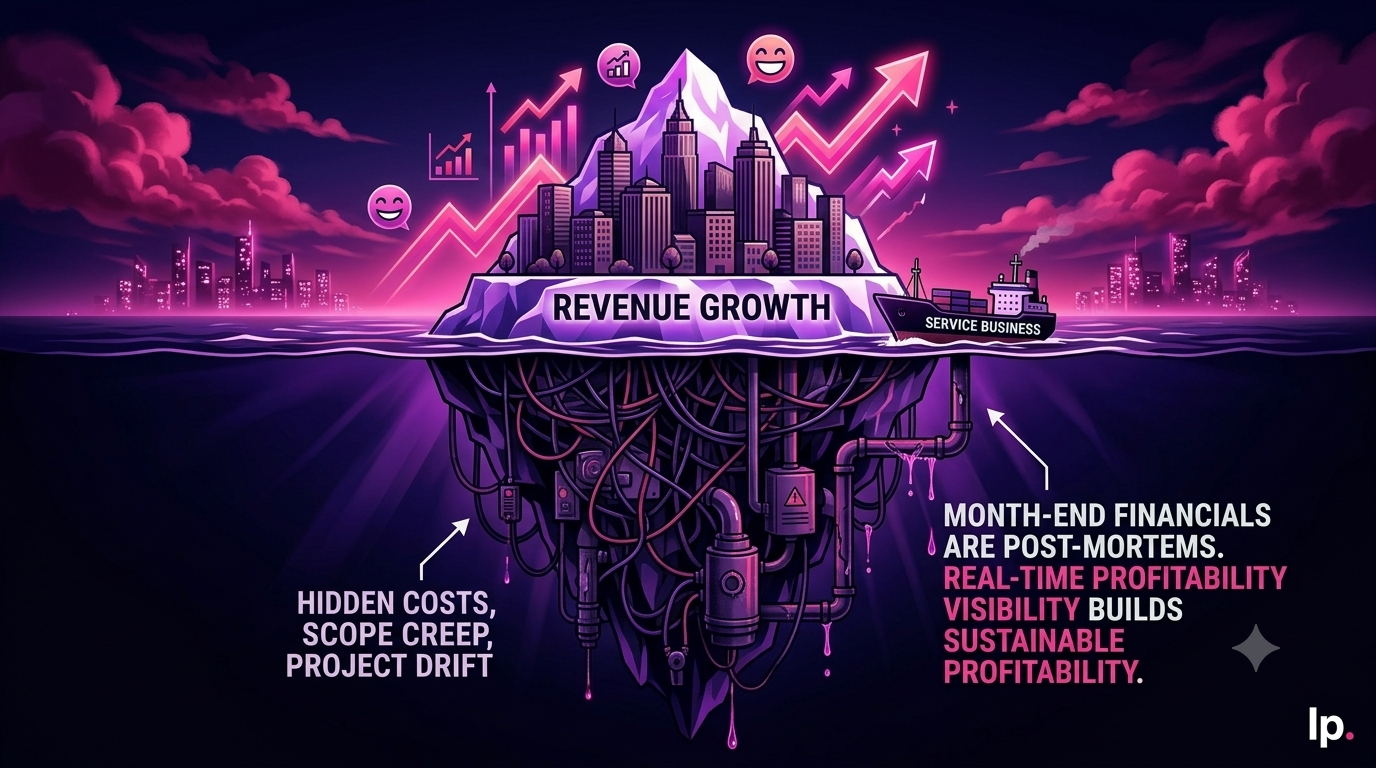
Revenue is usually the first number leaders celebrate. A new client signs. Another project kicks off. Monthly revenue climbs, the pipeline looks healthy, and from the outside, the business looks like it’s growing exactly as it should.
But behind those encouraging numbers, a different story is often playing out. Projects run longer than planned. Teams put in more hours than anyone budgeted for. Scope quietly expands without a single change order being raised. Margins shrink a little more each month, and cash gets tighter even as revenue keeps climbing.
If any of that sounds familiar, the real problem probably isn’t revenue at all. It’s that you can’t see where profit is being created — or quietly lost — until it’s already too late to do anything about it. This is the classic revenue vs profit trap: the top-line number goes up, and the business assumes everything underneath it is healthy too.
For IT services companies, software development firms, digital agencies, consulting firms, engineering services, and other professional services businesses, the hardest part was never winning more work. It’s knowing which of that work is actually turning into sustainable project profitability — and building real services business profitability, not just top-line growth.
Revenue Doesn’t Tell the Whole Story
Revenue answers exactly one question: how much business did we win?
It doesn’t tell you:
- Which projects are actually making money
- Which ones are consuming more effort than expected
- Which clients are eroding your margins
- Which teams reliably deliver profitable work
- Which “on track” projects are quietly turning into financial risks
Two firms can post identical revenue numbers in a given quarter and still end up in very different financial positions. That gap rarely comes down to sales performance — it comes down to execution, and to project margin.
Revenue measures how much you’ve grown. Profitability measures how well that growth actually converts into value. That distinction is at the heart of every project profitability conversation worth having.
The Visibility Gap Growing Service Businesses Face
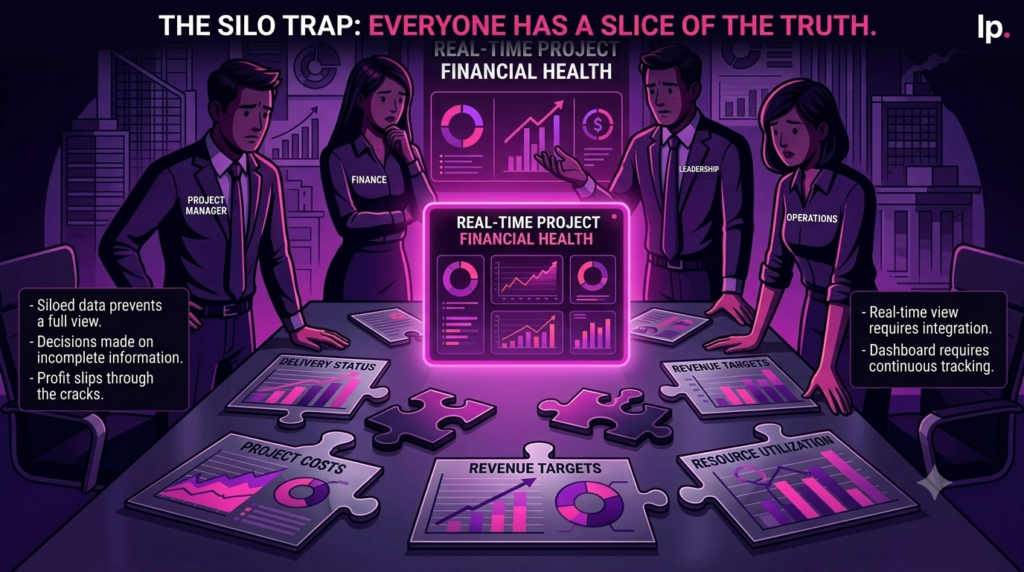
As service businesses grow, complexity grows right alongside them. More clients mean more projects. More projects mean more people. More people mean more coordination, more reporting, and more decisions made on incomplete information.
Before long, the picture fragments across the organization:
- Project managers watch delivery
- Finance watches costs
- Operations watches utilization
- Leadership watches revenue
Everyone owns a slice of the truth, but almost no one has a real-time view of the project financial health of every active engagement at once. That gap — between data that technically exists and insight that actually reaches decision-makers — is where profit slips through the cracks.
Why Profit Problems Are Usually Discovered Too Late
Most businesses only take a hard look at project profitability at month-end financial reports, at client invoicing, during quarterly business reviews, or once a project has already closed. By then, there’s nothing left to change. The extra hours have already been logged. The budget has already been blown through. The senior consultant has already spent three extra weeks bailing out a struggling engagement. The margin is already gone.
Picture a fixed-fee project scoped for ten weeks. By week six, the client’s requirements have shifted twice and nobody updated the estimate. No one flags it, because there’s no dashboard telling them to — the team just keeps working the way teams do, heads down, trying to hit the deadline. Ten weeks later, finance closes the books and finds the project ran 40% over budget. At that point it’s not a warning sign anymore. It’s a postmortem.
Financial reports are good at explaining what happened. They’re rarely fast enough to change what’s still happening. That’s the real difference between reporting and visibility: reporting looks backward, while true profitability visibility gives you room to act while there’s still time to change the outcome.
This is the shift that separates businesses that manage projects from businesses that manage profit. It isn’t about producing more reports — it’s about having continuous project cost tracking and margin data available the moment a project starts drifting, not the moment the books close on it.
The Hidden Connection Between Project Visibility and Cash Flow
Most leaders assume cash flow is primarily finance’s job to manage. In practice, cash flow problems usually start inside project delivery, long before they ever show up on a finance dashboard.
When a project runs over its planned effort without anyone flagging it, it doesn’t just eat into profitability — it sets off a chain reaction:
- Extra hours drive up delivery costs
- Delayed milestones push invoicing further out
- Senior resources stay tied up longer than planned
- New projects end up waiting on capacity that hasn’t freed up
- Payroll keeps running while revenue realization slows down
Eventually, leadership starts asking a familiar question: why is cash always tight when revenue keeps going up? The honest answer usually isn’t buried in the accounting system — it’s buried inside the projects themselves. Poor project visibility creates poor profit visibility, and poor profit visibility eventually shows up as a cash flow problem. Cash flow isn’t just a finance metric; it’s the downstream result of hundreds of delivery decisions made every single week.
The Real Growth Equation: Revenue < Project Visibility = Cash Flow
Most leadership dashboards stop at revenue, because revenue is the easiest number to point to. But on its own, revenue is actually the weakest signal in the room. The relationship that matters looks more like this:
Revenue < Project Visibility = Cash Flow (Real Growth)
- Revenue answers the simplest question a business can ask: how much business did we win?
- Project Visibility answers the questions revenue can’t — which projects are actually generating profit, which clients are quietly eating into margin, and which teams are under- or over-performing against what was estimated.
- Cash Flow answers the question leadership cares about most: is the business actually moving, or just holding its breath?
Revenue alone can’t get you to that last question. Project visibility is the layer underneath cash flow that makes the answer knowable in advance, instead of something you find out three months later. It’s what turns growth on a slide into growth you can actually bank on — and it’s why profitability visibility matters more than any single top-line number.
What each metric tells you — and what it doesn’t
| Metric | Tells you | Doesn’t tell you |
|---|---|---|
| Revenue | How much work you’ve sold | Whether that work is profitable |
| Profit | How much value was created | Which active projects are reducing margins right now |
| Cash Flow | Whether cash is available | Why cash is becoming constrained |
| Project Visibility | What’s happening inside projects right now | — it’s the layer that enables action before profit and cash are affected |
The Hidden Profit Leaks Most Businesses Miss
Profit rarely disappears in one dramatic event. It leaks out gradually, through dozens of small operational decisions that each look manageable on their own:
- Scope creep that never gets reflected in the original estimate
- Low billable utilization across the team
- Excessive internal meetings eating into delivery time
- Rework caused by shifting requirements
- Timesheets submitted late or inconsistently
- Resources allocated to the wrong project at the wrong time
- Projects quietly exceeding their estimated effort
- Unplanned, unbilled client support
Individually, none of these feels like a crisis. Together, they steadily erode margins and eventually put real pressure on cash flow — and because they build up gradually, they usually stay invisible until the financial reports finally reveal the damage.
Visibility Changes the Questions Leaders Ask
Organizations with strong project visibility tend to ask a different set of questions altogether. Instead of “how much revenue did we generate this month?”, they ask:
- Which active projects are drifting toward unprofitability?
- Where have effort estimates stopped matching reality?
- Which clients consistently need more work than scoped?
- Which teams consistently deliver the strongest margins?
- What can we fix this week instead of next month?
Those questions lead to faster decisions — and faster decisions are what actually protect profit before it disappears for good.
Profitability Isn’t Something You Fix After the Project Ends
One of the most common misconceptions in professional services is that profitability gets measured after delivery wraps up. In reality, it’s shaped continuously, throughout the entire project lifecycle. Every staffing decision, every scope conversation, every delayed approval, every extra meeting, every unplanned change request — each one nudges the financial outcome one way or the other.
Organizations that can see these signals early aren’t just producing cleaner reports. They’re building genuinely healthier, more resilient businesses.
Growth Without Visibility Isn’t Sustainable
Winning more projects doesn’t automatically translate into stronger financial performance — in fact, growth tends to magnify whatever inefficiencies already exist. More projects mean more complexity. More complexity means more uncertainty. And without visibility, it’s entirely possible for a business to grow revenue faster than it grows profitability.
That’s exactly why some service companies post record sales figures while simultaneously wrestling with thin margins, tough hiring calls, and a cash position that never feels comfortable. Growth on its own isn’t the goal. Profitable, predictable growth is.
Frequently Asked Questions
What is project profitability? Project profitability is the actual margin a project generates once all delivery costs — hours, resources, rework, overhead — are accounted for, not just the revenue it billed.
Why does a business grow revenue but still run short on cash? Usually because projects are quietly running over budget or over effort. Delivery costs rise, invoicing gets delayed, and resources stay tied up longer than planned — all before finance ever sees it in a report.
How is project visibility different from financial reporting? Financial reporting looks backward at what already happened. Project visibility surfaces margin and effort data while a project is still in progress, giving leaders time to act instead of just explaining the outcome afterward.
Conclusion
Revenue fuels growth. Profit measures how well the business is actually performing. Cash flow keeps the lights on. But all three depend on something many organizations still overlook: visibility.
When leaders can see, in real time, how every project is performing while the work is still in progress, they can catch risks earlier, protect margins, make sharper resourcing decisions, and strengthen cash flow before problems turn into losses. In a growing service business, revenue isn’t what makes you resilient. It’s Visibility.